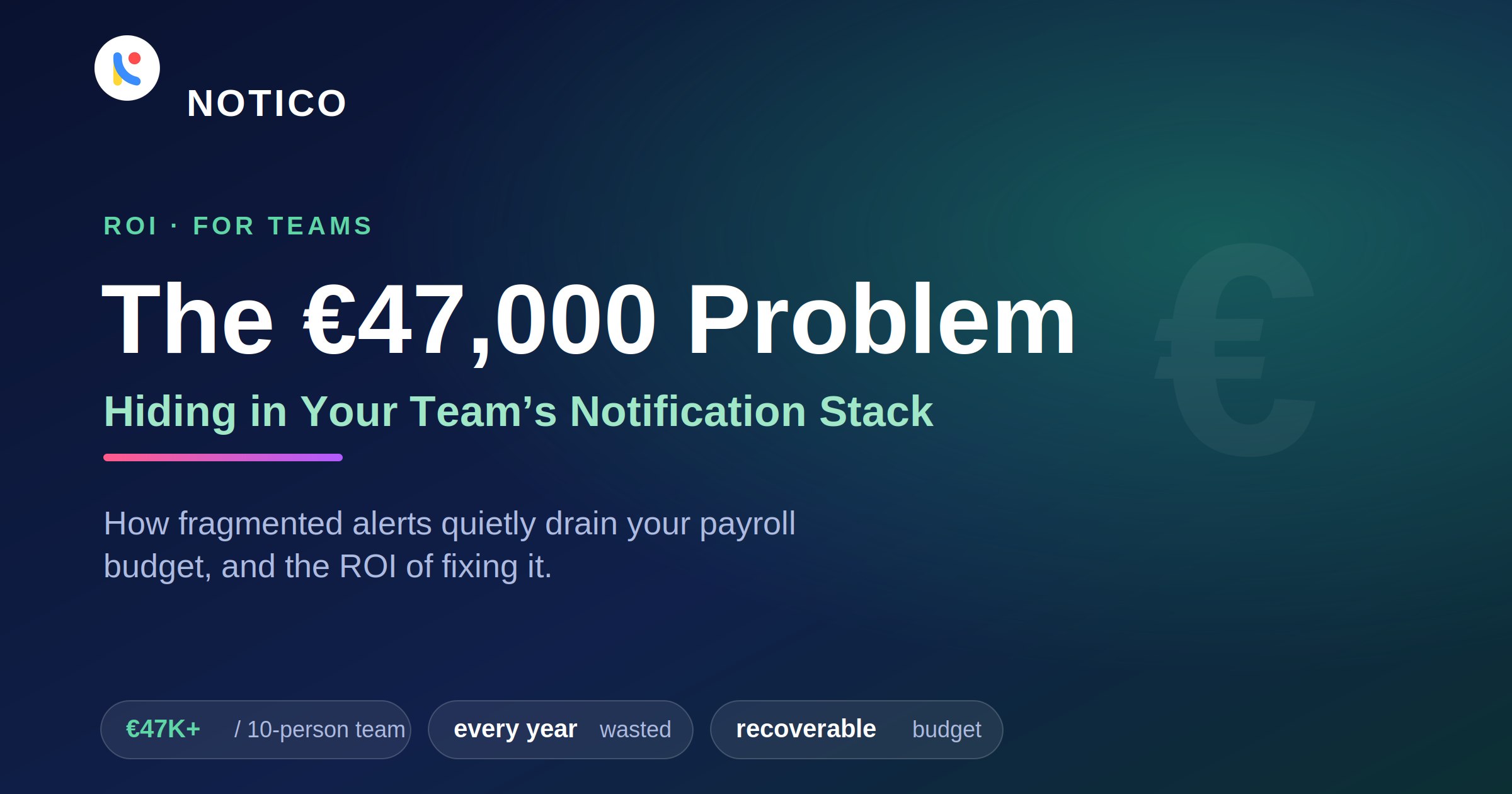
Most finance teams track software spend, headcount and office costs down to the euro. Almost none track distraction cost, the money that quietly evaporates every day as a team context-switches between notification sources, hunts for buried messages, and spends the first 20-odd minutes after each interruption trying to find their place again. For a team of ten, that invisible line item runs into five figures a year.
The hidden payroll drain
Notification chaos rarely shows up as a number anyone is accountable for, which is exactly why it persists. There is no invoice for the Slack ping that derailed a developer mid-task, or the buried email that turned into a reworked client deliverable. But the cost is real, and it compounds with every new tool you add to the stack. The more places work can interrupt you from, the more the bill grows.
This is not a culture problem you can fix with a "please check Slack less" message. It is an infrastructure problem, and infrastructure problems have infrastructure solutions.
Running the numbers
Let's be deliberately conservative. Assume each of your ten employees loses just 90 minutes of effective work per day to notification-driven interruptions and context switching. That is a cautious figure, the research on context switching suggests the real number is often higher. At a fully-loaded cost of €25 per hour, here is what that adds up to:
| Input | Value |
|---|---|
| Time lost per person, per day | 90 min |
| Fully-loaded cost per hour | €25 |
| Cost per person, per day | €37.50 |
| Team size | 10 |
| Working days per year | 250 |
| Full annual cost | €93,750 |
| Conservative (halved) | €46,875 |
Even if you halve the full estimate to be safe, you are looking at roughly €47,000 a year, a five-figure drain caused entirely by poor notification infrastructure. For SMEs and scale-ups on tight margins, that is not a rounding error. It is a material budget line.
How the cost scales with headcount
The figure is linear, so it climbs quickly as you grow. The same conservative math across different team sizes:

Where the money actually goes
The cost hides across three mechanisms. The first two are easy to picture; the third is the one that quietly does the most damage.

That third category, quality degradation, is the hardest to quantify and often the most expensive. A miscommunication that leads to a reworked deliverable, a missed detail in a contract review, a proposal sent with the wrong pricing, these errors trace back to interrupted focus in ways that are rarely acknowledged but entirely predictable. They just never get filed under "notifications."
The ROI of fixing it
This is where consolidation changes the equation. A unified notification inbox pulls every team alert, Slack, Gmail, Outlook, Asana, ClickUp, Jira and more, into one prioritised view. That attacks the two largest cost buckets directly: fewer switches means less recovery time, and one searchable inbox means less time hunting for buried messages.
Designed to claw back the most expensive minutes
In Notico's design targets, users find the notifications they need around 60% faster and identify critical alerts about 40% more reliably. Treat these as product estimates rather than independent findings, but even a fraction of that recovered against a €47,000 baseline pays for the tool many times over.
See Notico for teamsMaking the business case
You do not need to win an argument about willpower or work ethic. You need a simple before-and-after: estimate the minutes your team loses to scattered alerts today, multiply by their loaded hourly cost, and compare it to the price of a tool that removes most of those switches. Against a five-figure annual baseline, the math tends to make itself. Notification infrastructure is one of the rare line items where a small monthly cost offsets a very large hidden one.
Frequently asked questions
How much does notification overload cost a business?
It depends on team size and salaries, but the math adds up fast. For a 10-person team losing about 90 minutes a day each to interruptions and app switching, at a fully-loaded €25 an hour, the conservative figure lands around €47,000 a year, and it scales linearly with headcount.
Is the €47,000 figure realistic?
It is deliberately conservative. The full calculation comes to roughly €94,000 a year for ten people; €47,000 is that number halved to stay on the cautious side. Independent research suggests the true cost is often higher.
Where does the money actually go?
Three places: direct time lost reading and answering low-priority pings, recovery time spent refocusing after each interruption, and quality degradation, the errors and rework that come from doing complex work in a fragmented state.
How does a unified notification inbox improve ROI?
By cutting the number of switches and the time spent hunting for messages. Consolidating Slack, Gmail, Outlook and Asana into one prioritised inbox reduces both the direct time loss and the recovery cost, which is where most of the hidden spend sits.
The €47,000 is not a worst case. It is the conservative case. The first step to recovering it is simply measuring what scattered notifications already cost you.