You sit down to do the one task that actually matters today. Then Slack pings. You glance, reply, come back, and a calendar alert slides in. By lunchtime you have touched a dozen apps and finished almost nothing that required real thought. That feeling has a name, context switching, and decades of research show it is far more expensive than it looks.
What context switching actually is
Context switching is moving your attention from one task, tool or conversation to another. Each switch forces your brain to set down the rules of the task you were on and pick up the rules of the next one. It feels instant, but it is not free. Psychologist Sophie Leroy at the University of Washington described why: when you jump tasks, a portion of your attention stays stuck on the previous one. She called it attention residue, and it is the reason you can be physically looking at a new document while half your mind is still replaying the Slack thread you just left.
This is also why "multitasking" is mostly a myth. The brain cannot run two demanding tasks at once, so what feels like doing two things is really switching between them very fast, paying the switch cost on every jump.
How fragmented work became the default
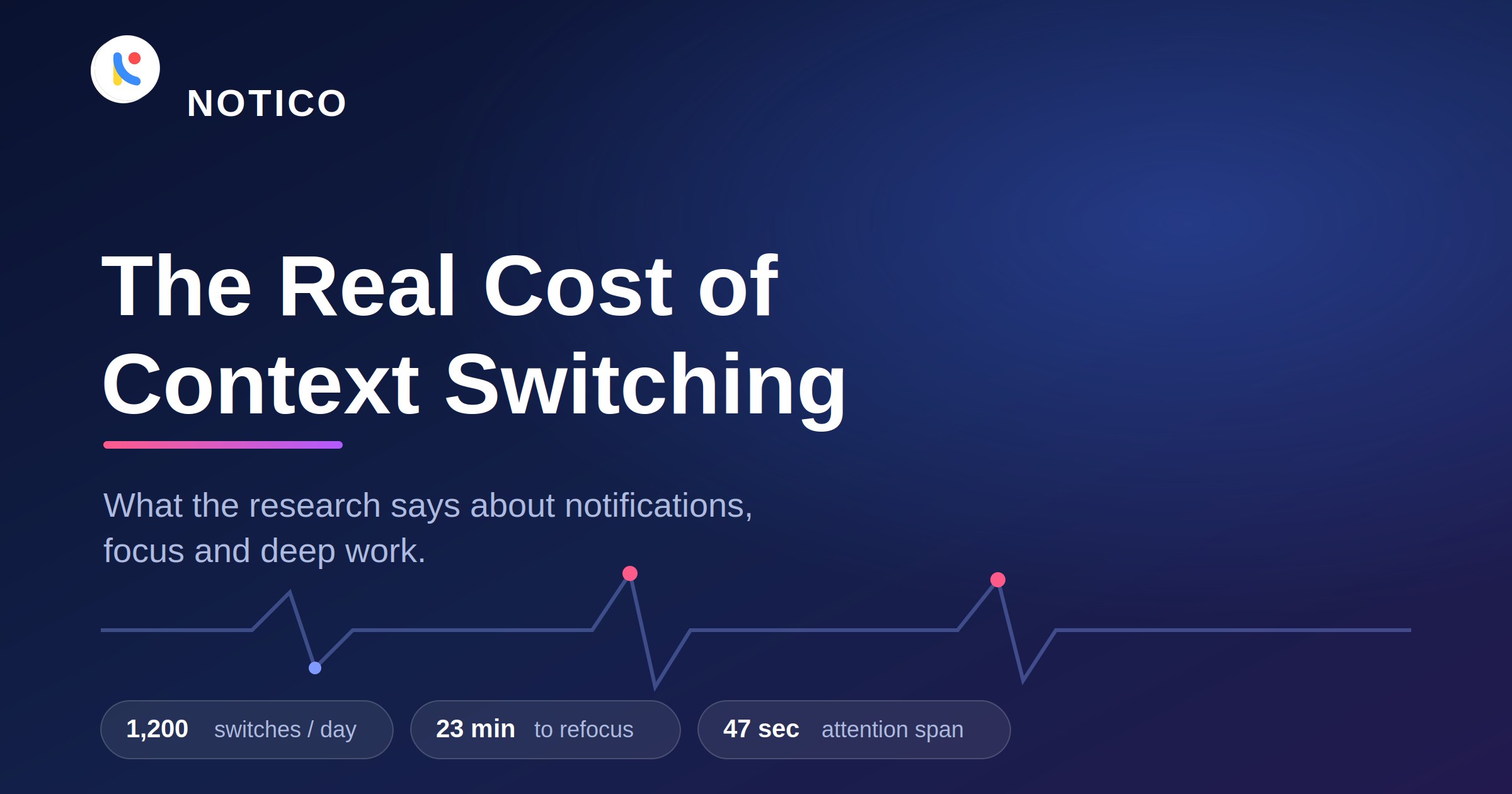
The modern workday is built out of interruptions. A landmark Harvard Business Review study tracked 137 people across three Fortune 500 companies and found they toggled between apps and websites around 1,200 times a day. The toggles themselves are quick, but reorienting afterwards added up to nearly four hours a week, about 9% of work time, or roughly five working weeks a year lost to nothing but switching.
Our capacity to resist all that has been shrinking at the same time. Informatics professor Gloria Mark has tracked attention on screens for two decades. In 2004 the average person stayed on one screen for about two and a half minutes before switching. By 2012 it was 75 seconds. In her most recent data it is just 47 seconds.

And it is not all the boss's fault. Mark's research found that roughly 44% of interruptions are self-generated, the reflexive tab check, the "let me just glance at email." We have trained ourselves to switch.
The real cost: time, money and mental load
Start with the raw time. A Qatalog and Cornell study found people lose 59 minutes every working day just searching for information scattered across apps. Layer that on top of the reorientation time from app switching and a meaningful slice of the day vanishes before any deep work happens.

Then there is the recovery cost, which is where it gets brutal. Gloria Mark's earlier UC Irvine work found that after an interruption it takes an average of 23 minutes and 15 seconds to fully return to the original task, partly because you usually handle about two other tasks before getting back. Do the math on a normal day and a handful of interruptions can quietly erase hours of real focus.

The bill is not only measured in minutes. Research summarised by the American Psychological Association suggests chronic switching can swallow up to 40% of productive time. In the Qatalog and Cornell survey, 45% of people said toggling between tools makes them less productive and 43% called it mentally exhausting. That exhaustion is the hidden tax: decision fatigue, more errors, and the creeping sense of being busy all day with nothing to show for it.
Why "just focus harder" doesn't work
The instinctive fix is willpower: try harder, check less, be more disciplined. It fails because the problem is structural, not moral. When alerts arrive across eight different apps with no priority and no order, your brain has no way to know which ping is a five-alarm fire and which is a thumbs-up emoji, so it treats them all as urgent. Attention residue means even the pings you ignore still cost you, because part of your mind keeps monitoring the channel. You cannot out-discipline an environment that is designed to fragment you. You have to change the environment.
How to reduce context switching
The good news is that most of the cost is recoverable. A few changes do the heavy lifting:
- Batch similar work. Group email, messages and admin into a few fixed windows instead of reacting all day. Fewer switches, fewer recovery cycles.
- Protect real focus blocks. Use do-not-disturb and calendar blocks so deep work gets uninterrupted runways, not 47-second slivers.
- Cut the number of tools you check. Every extra app is another place to switch to. Consolidate where you can.
- Default to async. Not every message needs an answer this minute. Treat most as save-for-later, not interrupt-now.
- Route every alert into one prioritised place. Instead of hunting across apps, let the important things surface to a single inbox so you decide what earns a switch.
The structural fix: one prioritised layer
That last point is the one that changes the math. If the root cause of context switching is alerts scattered across too many apps with no intelligence connecting them, the fix is a layer that sits on top and does the sorting for you. That is exactly what a unified notification inbox is built to do: pull Slack, Gmail, Outlook and Asana into one feed, rank by priority, and let low-value noise wait.

Pair that with a morning briefing that summarises what happened while you were offline, and the default flips: instead of being interrupted into switching, you choose when to engage. The 23-minute recovery tax only applies when you get yanked away mid-task. Remove the yank and the focus comes back.
Give your attention one calm place to land
Notico unifies Slack, Gmail, Outlook and Asana into a single prioritised inbox, with smart filtering and a daily AI briefing, so you switch on your terms instead of theirs.
Join the waitlist, free early accessFrequently asked questions
What is context switching at work?
Context switching is the act of moving your attention from one task, app or conversation to another. Every switch forces your brain to unload the rules of the old task and load the new ones, which carries a measurable cognitive cost even when the switch feels instant.
How much does context switching cost in productivity?
Research summarised by the American Psychological Association suggests chronic task switching can consume up to 40% of someone's productive time. Harvard Business Review found workers reorient for nearly four hours a week after app switches alone, roughly five working weeks a year.
Is context switching the same as multitasking?
Effectively, yes. The brain cannot truly run two demanding tasks at once, so what feels like multitasking is really fast switching between them, paying the switch cost each time.
How long does it take to refocus after an interruption?
Gloria Mark's UC Irvine research puts the average at 23 minutes and 15 seconds to fully return to the original task, partly because people tend to handle two other tasks before coming back.
How can I reduce context switching?
Batch similar work, protect focus blocks with do-not-disturb, cut the number of tools you check, default to async, and route every alert into one prioritised inbox so you stop hunting across apps.
The research
- Harvard Business Review (2022), How Much Time and Energy Do We Waste Toggling Between Applications?
- Gloria Mark, UC Irvine, on the 23-minute recovery cost, via Gallup, and on the 47-second attention span, via Steelcase Work Better.
- Qatalog and Cornell University Ellis Idea Lab, Workgeist Report (2021), via VentureBeat.
- Sophie Leroy, University of Washington, on attention residue; American Psychological Association on the cost of multitasking.
Attention is the one resource you cannot batch-produce. The less of it you spend switching, the more of it you keep for work that actually matters.